 +91-98995 89111
 Itsec@alliedboston.com
Red Teaming
Security
Think Like an Attacker. Defend with Confidence.
Check your applicable
compliances



Red Teaming Security
Red Teaming refers to a structured, adversary‑led security exercise that simulates real‑world cyberattacks to evaluate an organization’s ability to prevent, detect, and respond to advanced threats.
Organizations face sophisticated attackers who exploit technical weaknesses, human behavior, and process gaps to gain unauthorized access and achieve high‑impact objectives. At Secure n Comply, we conduct controlled Red Team engagements that emulate real threat actors to identify security blind spots across people, processes, and technology.
Red Teaming is critical to assess true security readiness beyond traditional testing by validating detection, response, and resilience under realistic attack scenarios. Common attack techniques include:
-

Initial Access Attacks: Attackers attempt to gain a foothold through phishing, credential abuse, exposed services, or social engineering to bypass perimeter defenses.
-
Privilege Escalation and Lateral Movement: Once inside, attackers exploit misconfigurations, weak access controls, or credential reuse to move laterally and gain elevated privileges within the environment.
-
Command, Control, and Data Exfiltration: Attackers establish covert communication channels, evade detection mechanisms, and attempt to access or exfiltrate sensitive data while maintaining persistence.
Key Benefits

Simulate real‑world attacks to test true organizational resilience.

Identify detection and response gaps across security controls and SOC operations.

Assess end‑to‑end security posture, including people, process, and technology.

Improve incident response readiness through actionable, attacker‑centric insights.

Strengthen defenses proactively before real adversaries exploit weaknesses.

Approach & Methodology
- Conduct a kickoff meeting to understand business objectives, critical assets, risk appetite, and engagement rules of engagement (RoE).
- Define scope, objectives, attack scenarios, timelines, and escalation paths.
- Identify target environments such as external perimeter, internal network, cloud, applications, endpoints, and users.
- Establish engagement constraints to ensure business continuity and safety.
- Model realistic threat actors based on industry, geography, and organizational profile.
- Define attack paths aligned with real‑world adversary tactics, techniques, and procedures (TTPs).
- Map planned activities to frameworks such as MITRE ATT&CK.
- Prepare infrastructure, tooling, and payloads required for the engagement.
- Perform stealthy reconnaissance to identify exposed assets, weak services, and attack vectors.
- Execute controlled attacks including phishing, credential harvesting, exploitation of vulnerabilities, and social engineering (as in scope).
- Attempt privilege escalation, lateral movement, and persistence while evading detection.
- Simulate command‑and‑control activities to assess monitoring and response capabilities.
- Attempt to achieve predefined objectives such as access to sensitive systems, data, or business‑critical functions.
- Validate the potential impact without causing disruption or data loss.
- Document attack paths, bypassed controls, and detection gaps.
- Reporting & Risk Evaluation
- Prepare a detailed Red Team report covering attack narrative, techniques used, timelines, and achieved objectives.
- Highlight detection failures, response gaps, and control weaknesses.
- Provide risk evaluation based on business impact and attacker success probability.
- Share prioritized remediation recommendations.
- Support Blue Team and security stakeholders with remediation guidance.
- Conduct debriefing sessions and knowledge transfer workshops.
- Optionally perform Purple Team exercises to validate improvements.
- Deliver final reports and executive summaries.
Deliverables
As a leading cyber security firm, Secure n Comply emphasizes fully communicating the value of its service and findings.

- Executive New Report
- Remediation
- Compliance Certificate
- Support by Technical Experts
- Suggestions as per Industry Best Practices
Social Engineering
Phishing Simulation

Blue Teaming
Services
Compliance Management System
Compliance Assessment Framework
Solutions
Our Engagement Model
Discover & Define


Mind the Gap
Assess & Treat Risks


Deploy Controls
Monitor & Improve

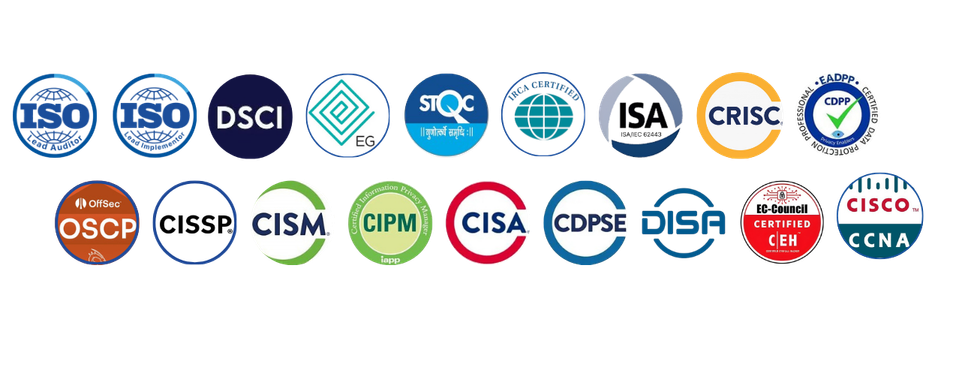
Backed by globally recognized
certifications
How We Support


Our Partners


Industries We Serve


Why Organisations Choose Us
Every organisation deserves a cybersecurity partner that delivers clarity, confidence, and technical excellence. At Secure n Comply, we combine deep domain expertise, industry-leading certifications, and modern security frameworks to address today’s complex cyber and compliance challenges effectively. Our customer-first mindset ensures solutions are practical, scalable, and aligned with your business goals. By leveraging advanced technologies and a proactive approach, we help organisations strengthen resilience, maintain compliance, and stay secure from day one and beyond.
-
Innovative Security
-

Trusted Solutions
-

Client Focused
-

Certified Experts
0+
Applications secured
0+
IPs Secured
0+
Cybersecurity Projects
0+
Compliance
Read Our Latest
Blogs

 May 25 , 2026


